Ramblings on IT and Security

Tag: Active Directory (Page 1 of 3)

Part 3: Installing the Certificate Enrollment Web Service (CES)

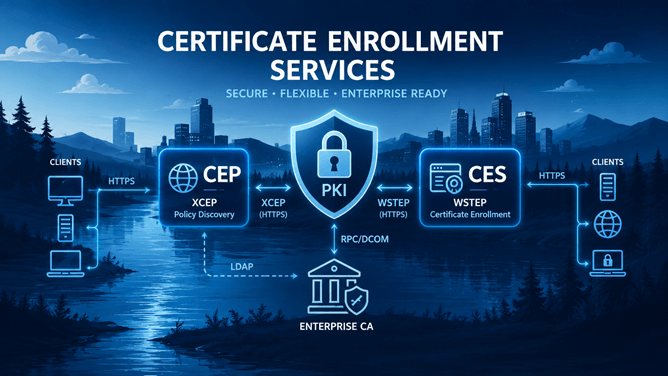
In the previous article, we deployed the Certificate Enrollment Policy Web Service (CEP) and configured support for Kerberos, Username/Password, and Client Certificate authentication. Clients can now successfully retrieve certificate enrollment policies over HTTPS using the XCEP protocol. However, while the policy infrastructure is now in place, clients still have no way to request certificates.

In this article, I’ll complete the Microsoft Certificate Enrollment Services architecture by deploying the Certificate Enrollment Web Service (CES). I’ll prepare Active Directory, configure a dedicated Group Managed Service Account (gMSA), install IIS, deploy the CES role, configure the supported authentication methods, and validate the deployment using PowerShell. By the end of this article, you’ll have a fully operational Certificate Enrollment Web Service capable of securely processing certificate requests over HTTPS using the WSTEP protocol.

Continue reading

Part 2: Installing the Certificate Enrollment Policy Web Service (CEP)

In the first article of this series, I explored the architecture behind Microsoft Certificate Enrollment Services (CEP & CES) and discussed why Microsoft introduced these web services.I looked at the differences between traditional Active Directory Certificate Services enrollment and the HTTPS-based enrollment model, explained the XCEP and WSTEP protocols, and followed the complete certificate enrollment process from start to finish. Now it’s time to move from theory to implementation.

In this article, I’ll build a complete Certificate Enrollment Policy Web Service (CEP) from scratch using PowerShell. Rather than simply installing the Windows role, I’ll also prepare Active Directory, create the required security groups, configure a Group Managed Service Account (gMSA), install IIS, configure the supported authentication methods, and validate that the deployment is functioning correctly. By the end of this article, you’ll have a fully operational Certificate Enrollment Policy Web Service capable of serving enrollment policies over HTTPS using Kerberos, Username/Password, or Client Certificate authentication.

Continue reading

Part 1: Understanding Microsoft Certificate Enrollment Services (CEP & CES)

If you’ve ever worked with Microsoft Active Directory Certificate Services (AD CS), you’ve probably come across the Certificate Enrollment Policy Web Service (CEP) and the Certificate Enrollment Web Service (CES). While Microsoft provides documentation on both services, I often notice that the focus is on how to install them rather than why they exist and how they fit into the bigger picture.

When I started diving into CEP and CES myself, I quickly discovered that understanding the architecture is far more important than simply clicking through an installation wizard. Why are there two separate web services? What problem were they designed to solve? What are XCEP and WSTEP? And when should you actually consider deploying CEP and CES instead of relying on traditional certificate enrollment?

Continue reading

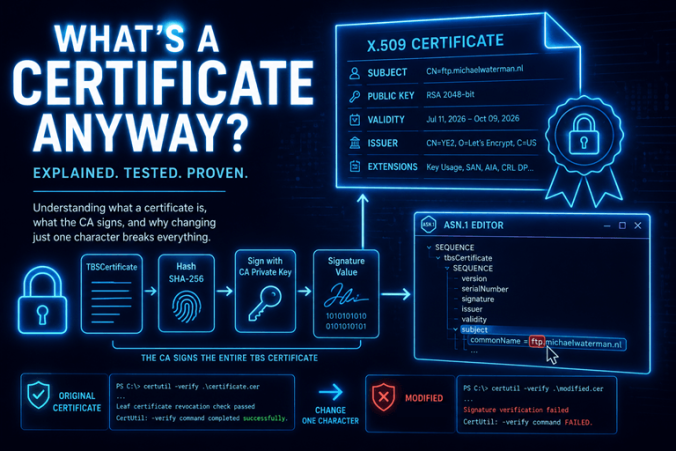
What’s a Certificate Anyway

One of the questions I get asked most often during assignments or workshops isn’t really about Certificate Revocation Lists (CRLs), OCSP, certificate templates or PKI in general. It’s much simpler than that.

“What’s a certificate anyway?”

Well actually, I sometimes start with the question, “So, can anyone explain to me what a certificate is or what it represents?”. You would think, it seems like an easy question to answer. Some people will tell you it’s your public key. Others will say it’s your digital identity. While both answers contain some truth, rarely the complete story is told. A digital certificate is much more than a single piece of information. It contains an identity, a public key, validity information, a collection of extensions, and much more. More importantly, all of that information is cryptographically protected by a trusted Certificate Authority (CA).

In other words, a certificate is a digitally signed document that binds an identity to a public key, with a couple of extensions. That digital signature allows anyone who trusts the issuing CA to verify that the certificate has not been modified and that the binding between the identity and the public key is authentic. But what exactly is inside a certificate? What does a Certificate Authority actually sign? And why does changing just a single character invalidate the entire certificate?

Let’s take a look under the hood of an X.509 certificate.

Continue reading

AD CS Performance Toolkit

During many of the Active Directory Certificate Services (AD CS) projects I work on, the discussion always turns to performance. “So Mike, how to we need to scale the machines?” Is the virtual hardware powerful enough? Do we have sufficient memory? How many CPU cores should the Certification Authority have? Is our Hardware Security Module (HSM) fast enough? Will disk I/O become a bottleneck? And perhaps the simplest question of all:

How fast is Active Directory Certificate Services actually?

Another challenge I regularly encounter is the need for a realistic Certification Authority database. Whether demonstrating reporting capabilities, validating certificate templates, testing custom PowerShell scripts, or creating a representative lab environment, an empty CA database simply does not reflect production. After searching for a suitable solution, I realized that nothing really existed that combined realistic certificate generation with meaningful performance benchmarking. Existing tools either focused on enrollment or stress testing, but none provided detailed insight into where certificate issuance time was actually spent….so I built one.

The AD CS Benchmark & Performance Analysis Toolkit is a PowerShell-based utility that generates realistic PKCS#10 certificate requests, submits them through the native ICertRequest2 COM interface, optionally creates matching Active Directory objects, and records detailed timing information for every stage of the enrollment process.

Continue reading

Building a Highly Available CRL and AIA Distribution Platform for AD CS

Last time I wrote about the why a Certificate Revocation List (CRL) should be available for the majority of services that make use of certificates. One of those prime examples is the use of smartcards. When revocation can’t be checked, you simply can not logon. Most Microsoft PKI deployments start with a single web server hosting the CRL Distribution Point (CDP) and Authority Information Access (AIA) locations. While this works well for smaller environments or labs, it introduces a single point of failure. If the web server becomes unavailable, certificate revocation checking may fail and certificate validation can be disrupted across the environment.

Continue reading

The Reality Behind PKI Revocation Checking

Last week I attended an interesting PKI training from CQURE. I never really had any formal PKI training before, mostly because I’ve spent years learning it the way many infrastructure engineers do, by breaking things in labs, fixing production issues, and occasionally questioning my life choices while staring at certutil output at 2 AM.

Still, I thought it would be fun to join. Most of the material was already familiar, but I met interesting people, had some good discussions, and definitely learned a few new things along the way. If you want to get into Microsoft PKI, I can genuinely recommend the training. PKI is one of those subjects that somehow manages to be both incredibly boring and extremely fascinating at the same time.

One of the topics we discussed was revocation checking. In the Microsoft world, this usually means Certificate Revocation Lists (CRLs) or the Online Certificate Status Protocol (OCSP). What many people misunderstand, however, is that revocation checking is not some universally enforced security mechanism. Whether revocation is actually checked often depends entirely on the application, service, operating system, or even the exact API being used underneath.

Continue reading

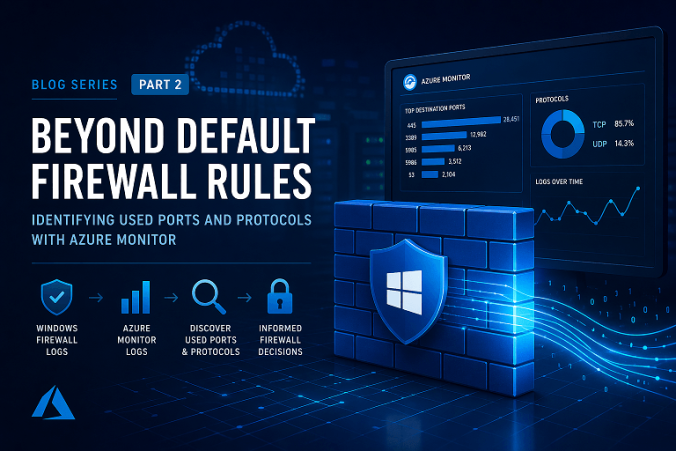
Monitoring Windows Firewall logs with Azure Monitor

In a previous blog, On-prem Conditional Access You Never Knew You Had I explored how the built-in Windows Firewall can be used as a powerful control mechanism to restrict access to systems, effectively bringing conditional access concepts to on-premises environments. The response to that post was overwhelming, with over 23,000 views on Reddit alone. Clearly, many organizations are interested in rethinking how they use the Windows Firewall beyond its default, often permissive configuration, and so should you/ But before you can confidently start restricting access, there is a fundamental question you need to answer:

What is actually being used in your environment?

In many cases, firewall rules have grown organically over time. Ports are opened “temporarily,” (read: we forget, so they will be open forever) exceptions are made for specific systems, and over the years, the rule set becomes difficult to understand, let alone control or optimize. Tightening those rules without proper insight is risky and can easily break critical services.

Continue reading

On-prem conditional access you never knew you had

We often associate Conditional Access with Entra ID, Cloud apps, and Zero Trust.
But long before cloud-native policy engines existed, Windows already had a way to enforce identity-based access between endpoints, and I mean really long ago. I would make the claim that we could go back to February of the year 2000, when Windows 2000 saw the light of day. Years later in the era of Windows Vista and Windows 7, we got the Windows Advanced Firewall and that can do so much more than just block or allow a port, I think it’s a really cool piece of software. The combination of Windows Firewall, Kerberos and IPsec effectively gives you on-prem Conditional Access for east-west traffic. In this post I’ll tell you a bit of history, which problems my blog solves and why you want to start using it. And for the folks that see the word “IPsec”, trust me, I’ll make it easy to use, promise!

Let’s dive in!

Continue reading
« Older posts

© 2026 Michael Waterman

Theme by Anders NorenUp ↑