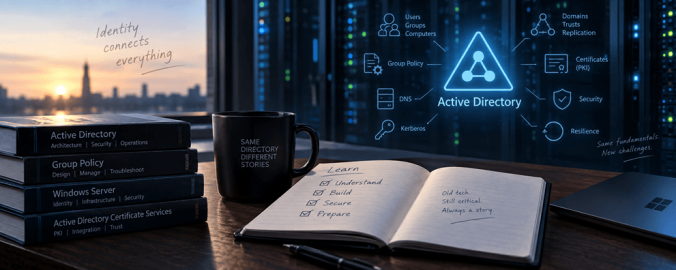
Active Directory has been around for more than 25 years. In IT terms, that is practically ancient history. And yet, walk into almost any established enterprise today and there is a very good chance that Active Directory is still somewhere near the center of its identity infrastructure. Users authenticate against it, computers depend on it, applications use it, Group Policy configures systems through it, Kerberos relies on it, and Certificate Services often integrates with it. Even increasingly cloud-focused organizations frequently have dependencies that eventually lead back to Active Directory.
That makes understanding Active Directory one of those skills that continues to be remarkably valuable. It is also deceptively easy to get started with. Install Windows Server, promote it to a Domain Controller, create a few users, groups and Organizational Units, configure a Group Policy and suddenly you have an Active Directory environment. Understanding what you have just built is another matter entirely.
This page is my collection of resources for anyone who wants to learn how Active Directory works. I have deliberately kept the list short. The objective isn’t to create the world’s largest collection of Active Directory bookmarks, but to provide a sensible path through the subject.
Start with the fundamentals
The best place to start is Microsoft’s own Active Directory Domain Services learning path. It provides a structured introduction to AD DS, covering the fundamentals, Domain Controllers and FSMO roles, Group Policy, advanced AD DS functionality and Active Directory Certificate Services.
Once the terminology starts making sense, Andy Malone’s 30-minute Active Directory crash course is a great way to connect the pieces. Thirty minutes obviously isn’t enough to become an Active Directory engineer, if it were, quite a few consulting careers would suddenly become considerably shorter, but it gives you a useful mental map of how the major components fit together.
From there, I would continue with John Savill’s Active Directory Domain Services deep dive. This is where you can start moving from knowing what the components are toward understanding why Active Directory behaves the way it does. That distinction becomes increasingly important when troubleshooting replication, authentication and trust problems, and absolutely essential once you start looking at Active Directory security.
Learn to operate it
At some point you need to move beyond theory and actually work with the technology. For that, the Active Directory Administration Cookbook is a useful practical reference.
I like the cookbook approach for infrastructure technologies because real administration rarely happens in the neat sequence used by training material. One day you are working with users and groups, the next you are troubleshooting replication, and shortly afterwards somebody asks about a trust relationship nobody remembered existed.
More importantly: build a lab. Create a forest, add another Domain Controller, configure sites, experiment with replication and Group Policy, look at Kerberos tickets and DNS, transfer FSMO roles and create a trust. And don’t be afraid to break things. A lab that never breaks teaches you considerably less than one that does.
Then start thinking about security
There is another reason why learning Active Directory remains important: in many organizations, it represents a substantial part of the enterprise security boundary. Compromise Active Directory at a sufficiently privileged level and the conversation quickly changes from we have a compromised server to which systems and identities can we still trust?
This is also where its age becomes relevant. Active Directory itself isn’t inherently insecure simply because it has existed for more than 25 years. The bigger problem is what decades of operational history can do to an Active Directory environment.
Administrators come and go. Applications are introduced and retired. Permissions are delegated. Service accounts accumulate privileges. Migrations leave artifacts behind. Temporary solutions become permanent because they work just well enough that nobody wants to touch them. Twenty years later, the resulting environment may contain security decisions for which nobody remembers the original question.
Semperis explores this problem in Why Active Directory’s 25-Year Legacy Is a Security Issue. It introduces an important lesson for anyone learning AD: technical debt accumulates in identity systems too, and identity technical debt can be particularly unpleasant.
The next logical step is understanding how to protect it. The Essential Guide to Securing Microsoft Active Directory moves the discussion from administration toward the weaknesses that can turn perfectly normal Active Directory functionality into an attack path.
And finally, think about recovery
The final subject that belongs in any serious Active Directory learning path is recovery. Not backup. Recovery. Those two words are related, but they are definitely not interchangeable.
Averting Disaster: Preparing Your Organization for an Active Directory Failure is therefore a good way to finish this collection.
Active Directory disaster recovery forces you to think about the directory as a dependency rather than just another workload. What happens when the identity infrastructure that administrators themselves depend upon is unavailable? Where are the recovery credentials? Which systems remain accessible? Does the recovery process depend on DNS? Which services need to return first? And has anybody actually tested a forest recovery rather than simply confirming that the backups completed successfully?
If you are completely new to Active Directory, my suggested path is therefore simple: start with Microsoft Learn, use Andy Malone’s crash course to connect the concepts, then take the deeper dive with John Savill. Build a lab alongside it and use the cookbook as a practical reference. Once you understand how Active Directory works, start looking at it from a security and recovery perspective using the Semperis material.
Active Directory may be more than 25 years old, but that doesn’t make understanding it obsolete. Modern identity environments are increasingly hybrid, authentication is changing, passwordless technologies are becoming more important and applications continue to move to the cloud. But old trust doesn’t disappear simply because new technology arrives.
Enjoy!