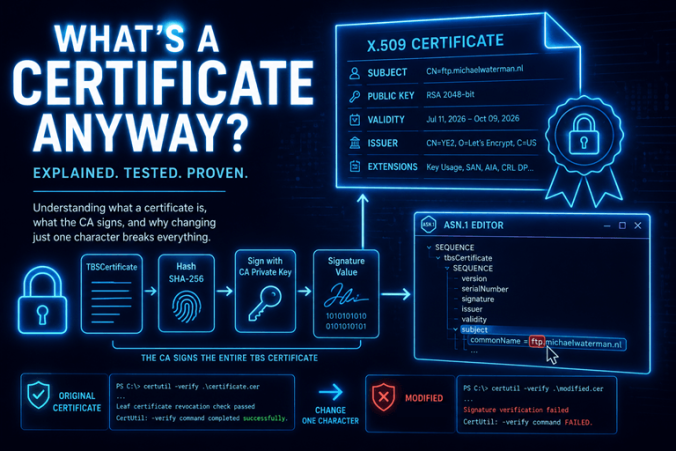
One of the questions I get asked most often during assignments or workshops isn’t really about Certificate Revocation Lists (CRLs), OCSP, certificate templates or PKI in general. It’s much simpler than that.
“What’s a certificate anyway?”
Well actually, I sometimes start with the question, “So, can anyone explain to me what a certificate is or what it represents?”. You would think, it seems like an easy question to answer. Some people will tell you it’s your public key. Others will say it’s your digital identity. While both answers contain some truth, rarely the complete story is told. A digital certificate is much more than a single piece of information. It contains an identity, a public key, validity information, a collection of extensions, and much more. More importantly, all of that information is cryptographically protected by a trusted Certificate Authority (CA).
In other words, a certificate is a digitally signed document that binds an identity to a public key, with a couple of extensions. That digital signature allows anyone who trusts the issuing CA to verify that the certificate has not been modified and that the binding between the identity and the public key is authentic. But what exactly is inside a certificate? What does a Certificate Authority actually sign? And why does changing just a single character invalidate the entire certificate?
Let’s take a look under the hood of an X.509 certificate.
Continue reading